

The Margarita-Huacaya Field
Analogue Spotlight
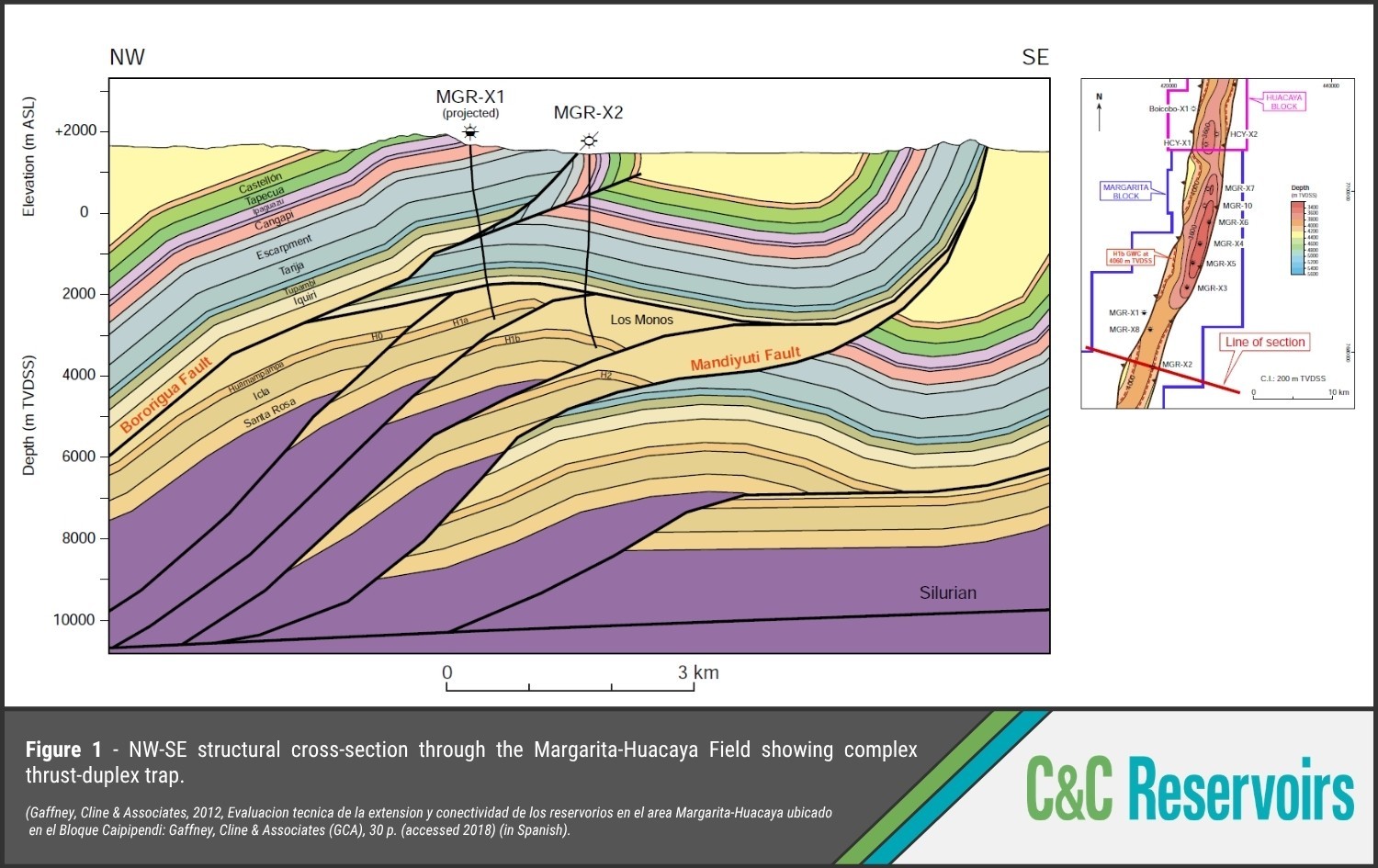
Discovered in 1998, Bolivia’s Margarita-Huacaya Field lies within a complex Sub-Andean thrust duplex (Fig. 1), holding a significant Gas-Initially-In-Place (GIIP) of 6537 BCF and an Estimated Ultimate Recovery (EUR) of 3355 BCF. However, there were initial concerns when the discovery well, MGR-X1, yielded just 27.7 MMCF/day – a flow rate deemed too low for commercial viability. The culprit? Poor reservoir quality, with matrix porosity averaging only 4% and matrix permeability mostly below 0.01 mD.
Fortunately, extensive natural micro- and macro-fracturing of the reservoir provided connected pathways for fluid flow. With fracture porosity averaging 0.7%, giving an average bulk porosity of 4.7% and inter-well permeability along the structural crest – where fractures are most concentrated – reaching an impressive 7400 mD, the solution was to target these directly using high-angled wells.
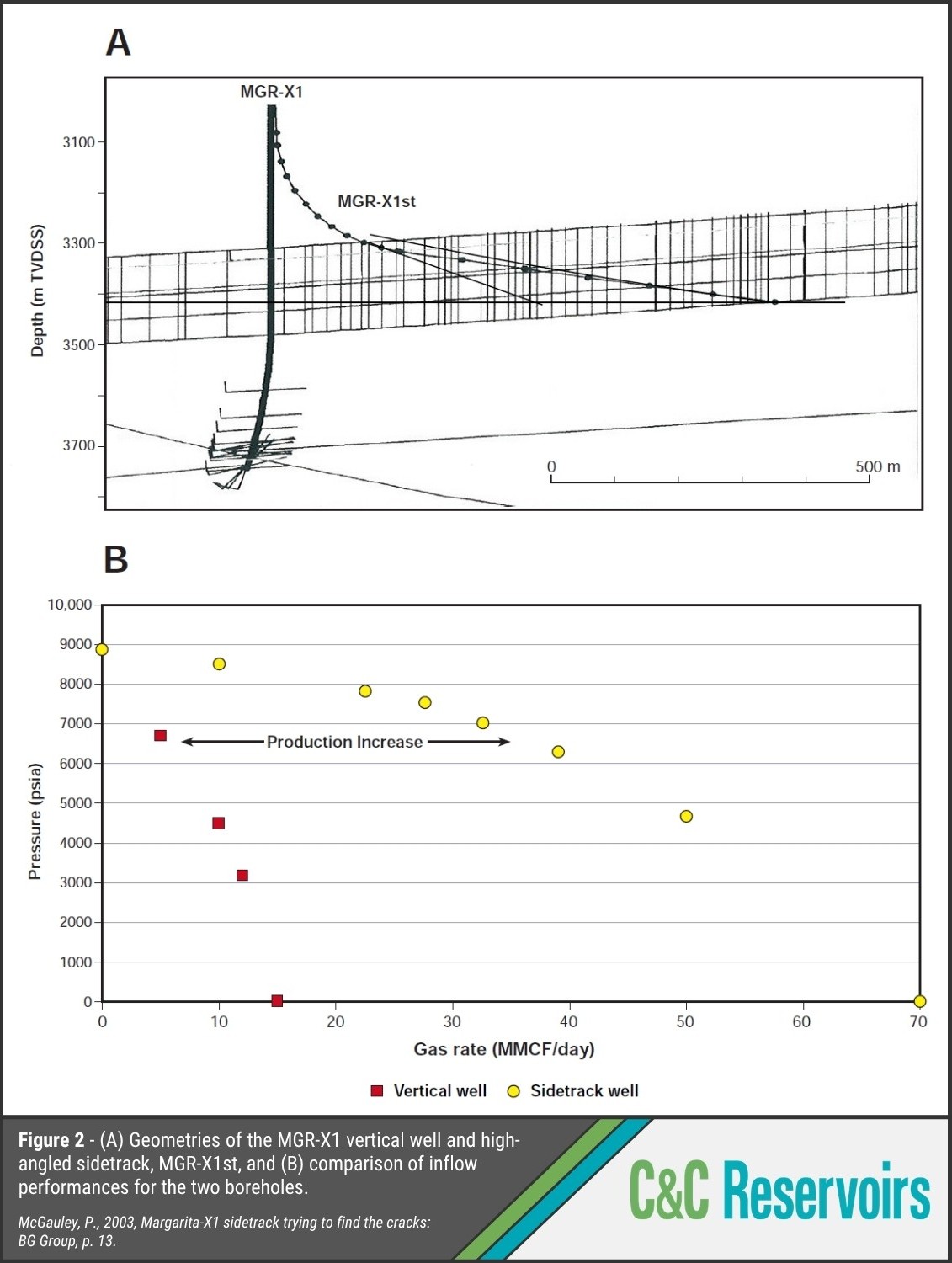
The breakthrough came with a highly-deviated sidetrack drilled from MGR-X1 at an inclination of 82° with 1 km of extended reach. The results were remarkable – gas production increased by a factor of 5-10 (Fig. 2).
By 2023, a total of eleven wells had been drilled: two vertical, three deviated and six highly deviated (>75° inclination). To optimize productivity, wells were drilled parallel to the NNE-trending structural axis (perpendicular to principle horizontal stresses) – In order to maximise exposure to the widest aperture and most productive open fractures. These highly inclined wells also helped mitigate excessive pressure drawdown and water coning, although they introduced a new challenge: increased mud loss into fractures.
Despite these complexities, the Margarita-Huacaya Field stands as a testament to how innovative well design and fracture analysis can unlock the full potential of even the most challenging reservoirs.